
When you’re planning the acoustic design in your spaces, it’s easy to jump straight into materials–acoustic panels, baffles, and diffusers. But the most effective spaces always start with something more fundamental: the physics of how sound actually behaves within enclosed spaces. Once you understand how sound waves move, interact, and dissipate, design decisions suddenly feel intentional instead of trial-and-error. This guide walks through the core science behind acoustics and shows how MaterialLogIQ products can help.
What are Sound Waves?
Sound is a mechanical wave–a rhythmic alternation of compressions and rarefactions traveling through a physical medium. Air molecules push together and pull apart, passing energy along in the same way a slinky moves when you flick one end.
A key idea here: sound cannot travel without a medium. That’s why space is silent–you need air, water, or a solid for those alternating pressure changes to propagate.
If you visualized a simple sine wave, the crests would represent compressions and the troughs represent rarefactions, with the wave moving forward as each region pushes the next. This simple model underpins all of acoustic science, from why your voice reverberates in a gym to why bass leaks through walls more readily than treble.
Quick Glossary of Terms: Frequency, Amplitude, and Wavelength
Before diving deeper, a quick shared vocabulary helps translate the physics into day-to-day design choices.
Frequency (Hz)
Frequency is how many cycles of compression and rarefaction happen each second. Our ears interpret this as pitch.
- High Frequency → short, tight waves → sharper, brighter sounds
- Low Frequency → long, stretched waves → bass tones that travel far and bend around obstacles
Amplitude
Amplitude is the height of the wave, or the intensity of the pressure variation. We perceive amplitude as loudness. A larger amplitude wave pushes and pulls air molecules more dramatically, creating more perceived energy.
Wavelength
Wavelength is the distance between repeating points on the wave. Short wavelengths correspond to high frequencies; long wavelengths correspond to low frequencies. This relationship matters because wavelength determines how sound interacts with objects:
- Long wavelengths (bass) bend around columns, soffits, and partitions.
- Short wavelengths (treble) are more directional and reflect strongly off hard surfaces.
Speed of Sound
At room temperature, sound travels about 343 meters per second through air. That speed increases in warm air and is much faster in solids like steel. The speed of sound is important when syncing distributed loudspeakers or AV systems across large rooms–delays that are imperceptible up close become very noticeable over distance.
These fundamentals set the stage for how sound interacts with surfaces, how materials influence clarity, and why some rooms feel comfortable while others feel chaotic.
How Sound Waves Interact with Surfaces
Inside real-world rooms, sound waves rarely move in straight, uninterrupted lines. They collide with walls, ceilings, furniture, and openings–producing reflections, absorption, diffraction, diffusion (scattering), and sometimes surprising results. Understanding these interactions is central to good acoustic design.
Rooms with similar dimensions can sound completely different depending on surface finishes, geometry, and the distribution of absorptive versus reflective zones. Hard, parallel walls can produce strong flutter echo, while irregular or angled surfaces help scatter sound and prevent build-up at certain frequencies. Ceiling height also plays a role: rooms with high ceilings allow more room for reflections to decay, while low ceilings intensify early reflections that interfere with speech clarity. Even furnishings contribute–upholstered seating, bookshelves, curtains, and occupants all add absorption in the mid-high range.
Reflection and Absorption of Sound
Sound reflection occurs when waves hit a hard, flat surface like glass, concrete, tile, or polished metal. The air molecules bounce off the rigid boundary and change direction like a ping-pong ball off a table.
Reflections cause:
- Echo
- Longer Reverberation Time (RT)
- Lower speech intelligibility
- Hot spots where certain frequencies accumulate
Absorption works in the opposite direction. Instead of bouncing back, sound energy enters porous or resonant materials and is converted into a very small amount of heat via friction and movement inside the structure. The result:
- Shorter RT
- Improved clarity
- Reduced echo
- A more evenly balanced room sound
Most architectural environments blend reflective and absorptive zones to avoid rooms that feel either overly echoey or unnaturally dead.

Diffraction and Refraction in Acoustic Spaces
Diffraction describes how sound bends around obstacles or passes through small openings. It is why bass (with its long wavelengths) can slip around a bookshelf or doorway even when mid-high frequencies are blocked.
This principle helps explain:
- Why low-frequency noise escapes conference rooms
- Why you “feel” bass outside a venue
- Why acoustically isolating low frequencies requires mass and airtightness, not just absorptive panels
Refraction, by contrast, occurs when sound changes direction because its speed changes. This can happen at temperature gradients (warm air near the ceiling, cool air near the floor) or when a wave moves from one material to another. In tall atriums or large performance spaces, refraction can subtly bend sound fields, influencing how evenly audio coverage reaches the audience.
Scattering and Diffusion
Diffusion describes how an irregular surface scatters reflections across many directions, smoothing rather than eliminating energy. It prevents sharp echoes and helps music and speech sound more natural, especially in performance spaces.
Architectural diffusion is created with:
- Geometric surface reliefs
- Curved or faceted wood
- Patterned plaster
- Wood wool textures
- Engineered diffusers
Diffusion is especially valuable when you want clarity without over-absorbing the room.
Understanding these baseline room behaviors ensures that material choices aren’t made in a vacuum. Instead, they’re tied to measurable challenges: reverberation time, speech intelligibility, and the balance between direct and reflected energy. This broader view helps inform which MaterialLogIQ systems will deliver the most noticeable improvements.
How Different Materials Shape Sound
Different materials manipulate sound in different ways. The right choice depends on the frequencies you need to control, where the panels are installed, what aesthetic you’re targeting, and what performance metrics–such as NRC ratings, Class A fire-rated requirements, low-VOC materials, or LEED credits–must be met.
Below, we break down the mechanics, placements, and design strengths of four of MaterialLogIQ’s core acoustic systems.
InvisiPerf Metal
Mechanism
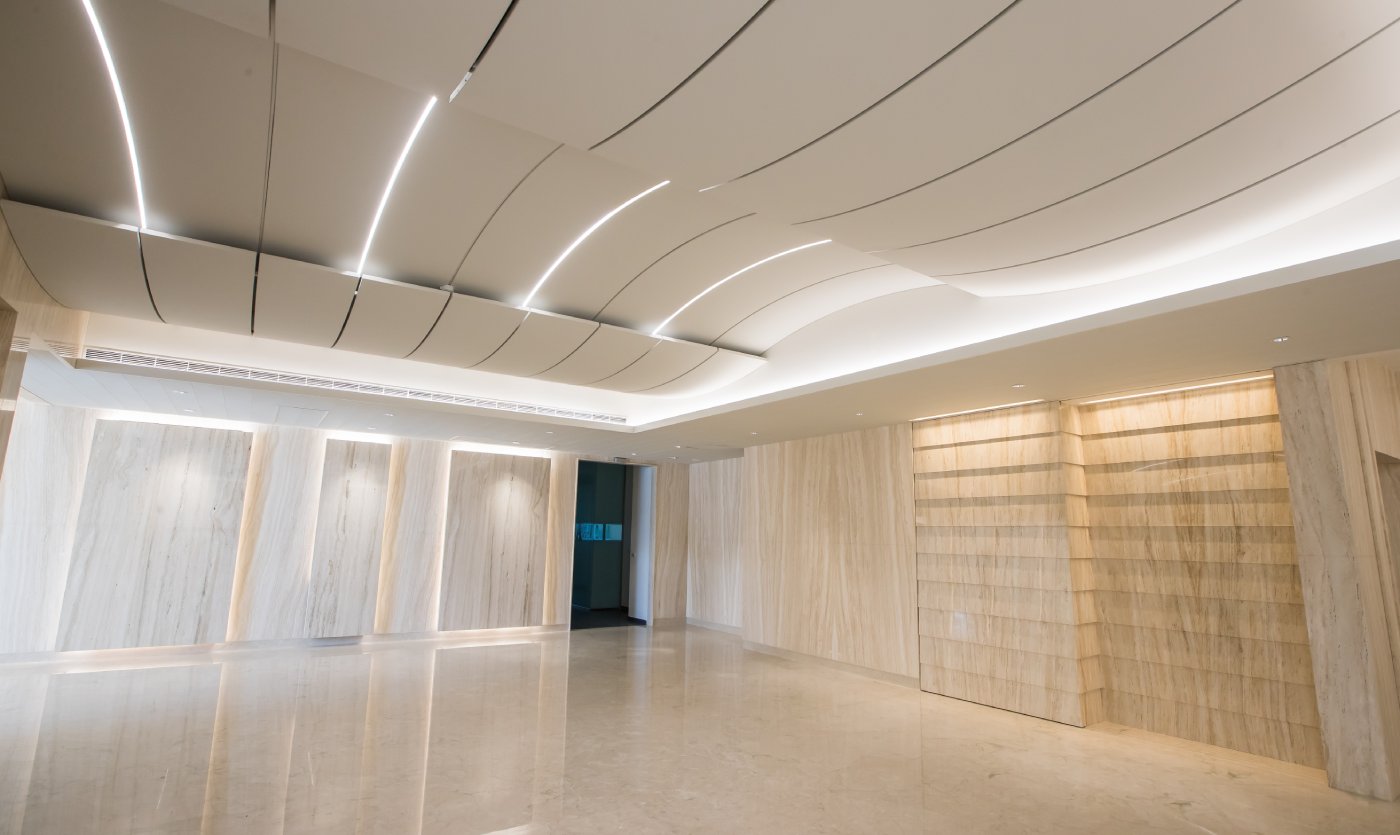
InvisiPerf Metal panels are made from a proprietary microperforated aluminum material, which has thousands of microscopic holes backed by an air cavity to create a Helmholtz-like absorption system. As waves hit the panel, air oscillates within each tiny hole, dissipating energy through viscous friction. When combined with a tuned air gap, MPA can absorb both mid and certain low-mid frequencies–impressive performance for a smooth, cleanable surface.
Where it Shines
- High humidity areas like natatoriums, or indoor pools, where fibrous materials are not suitable
- High-traffic areas: transit halls, queues, galleries
- Ceilings and upper walls where durability and hygiene are priorities
- Spaces requiring a minimalist, continuous aesthetic without exposed fibrous materials
Design Notes
InvisiPerf Metal’s magic is in its proprietary combination of hole diameter, hole angle, open area percentage, and integral air cavity that delivers exceptional broadband absorption with a nearly monolithic surface texture.
InvisiPerf Metal is ideal when you need longevity, cleanability, and a sleek modern design aesthetic without sacrificing acoustic control.
Real-World Example
In a recent transit-hall installation, InvisiPerf Metal panels were used over long queuing lanes to reduce harsh flutter off polished stone floors. The micro-holes provided targeted mid-band absorption without interrupting the architectural rhythm of the ceiling. The result was noticeably clearer announcements and reduced fatigue from lingering reflections.
Wood Wool
Mechanism
Wood wool panels combine wood fibers (excelsior) with a mineral binder (cement) to form a porous, air-permeable matrix. Sound enters the fiber network and loses energy through internal friction, providing broad, balanced absorption. The fibrous texture also helps to gently diffuse sound, reducing slap echo and improving spatial uniformity.

Where it Shines
- Schools, gyms, and multipurpose rooms
- Restaurants and hospitality spaces needing a natural, textured look
- Studios and creative spaces where durability and acoustic performance must coexist
Design Notes
Thickness and density affect absorption bandwidth. Adding backers or varying panel profiles can help tune performance across the speech range and above. Engraved patterns or color treatments can add visual identity while maintaining function.
Wood wool frequently meets stringent fire requirements and contributes to LEED-aligned specifications through its material makeup and durability.
Real-World Example
A K-12 multipurpose room project used wood wool panels on the upper walls to control the room’s long reverberation time while retaining a natural aesthetic. Teachers reported better speech clarity during assemblies, and the maintenance team appreciated the panels’ durability compared to fabric-wrapped alternatives.
PET Felt
Mechanism
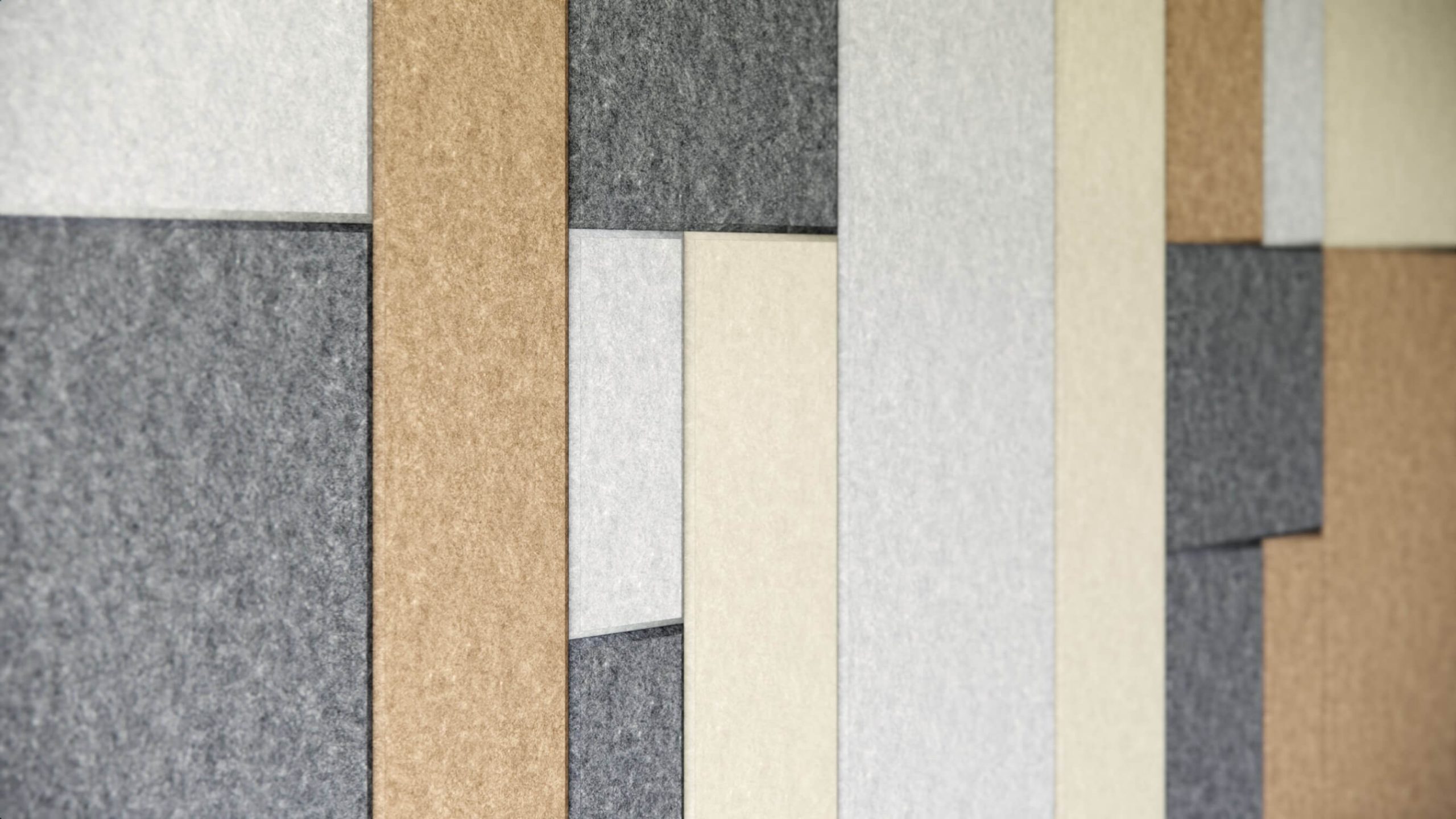
PET felt relies on dense fiber networks that allow air to move through slowly, converting sound energy into small, harmless amounts of heat. It is especially effective at controlling mid to high frequencies–ideal for speech-focused environments.
Where it Shines
- Open office ceilings and workstation zones
- Focus rooms, phone booths, and lounges
- Hospitality and seating areas
- Clouds, baffles, wall panels, dividers, and furniture wraps
Design Notes
Because PET felt is lightweight and easy to fabricate, designers can quickly implement custom shapes and zoning strategies. Thickness, spacing, and air gaps influence how low the material reaches into the frequency spectrum. With low-VOC materials and a broad color palette, PET felt is both performance-driven and brand-friendly.
Real-World Example
In an open-office retrofit, PET felt baffles reduced distraction by softening high-frequency reflections between the workstations. Because the felt was easy to CNC-cut, the design team created custom shapes that doubled as wayfinding cues–improving both acoustic comfort and spatial legibility.
Wood
Mechanism
Wood slats are not inherently absorptive, but when engineered with a high-performance PET felt backer, they form a powerful acoustic partnership. The felt actively absorbs unwanted sound while the wood diffuses and reflects, resulting in a perfectly balanced acoustic environment.

Where it Shines
- Auditoriums and lecture halls
- Worship spaces
- Corporate lobbies
- Performance and multiuse venues
Design Notes
Achieving optimal acoustic balance with wood slats involves strategic design choices. The core performance is determined by the combination of the wood’s density and the PET felt’s sound absorption rating (NRC). Designers must carefully consider the slat depth and the width of the open space between the slats (the “reveal”) to tailor the desired absorption curve. Often, designers will use varying slat dimensions across a large space to introduce subtle diffusion, preserving a natural, lively room response without sacrificing speech or musical clarity.
Acoustic wood products can meet Class A fire-rated requirements, contribute to LEED credits, and deliver a premium biophilic aesthetic.
Real-World Example
In a high-end commercial recording studio, wood slat acoustic panels were installed across the ceiling and rear walls. The varying depths of the slats were strategically placed to break up standing sound waves, while the integrated felt backer provided broadband absorption. This ensured the sound engineer achieved a crisp, natural room response essential for critical listening and mixing, effectively balancing the warmth of the wood with the studio’s demand for high-performance sound control.
How It All Comes Together
When you understand how waves behave and how materials respond, design decisions become a natural extension of the physics:
- Need clearer speech in a meeting room? Add mid-high absorptive materials like PET felt.
- Trying to reduce flutter echo in a gym? Wood wool’s porous texture helps break up reflections.
- Looking for a clean, durable surface that balances aesthetics with performance? InvisiPerf Metal offers tunable absorption with a seamless finish.
- Want a warmer, more natural acoustic character in a large hall? Wood slat panels mix reflection and absorption for an intentionally voiced acoustic profile.
The right mix–and correct placement–creates a space that feels controlled, comfortable, and aligned with the user experience.
Designing for Intentional Experiences
Different spaces call for different acoustic priorities. A gym should feel energetic but not overwhelming; a restaurant benefits from lively ambience without sacrificing conversation clarity; a classroom needs speech clarity above all else.
Effective acoustic design supports these goals by shaping how people experience a space moment-to-moment–what they hear, how easily they communicate, and how fatigued they feel after spending time there.
Material choices become a form of experience design: balancing reflection, absorption, and diffusion to guide how sound behaves. When these elements align, occupants don’t consciously notice the acoustics–they simply experience a space that feels comfortable, functional, and intuitively “right.” Adding this layer of intent elevates the project from material selection to experiential architecture.
Let Us Tune Your Space
Good acoustics rarely come from guessing. They come from understanding the wave physics, identifying the acoustic challenges, and selecting materials that solve those challenges both functionally and aesthetically.
MaterialLogIQ helps architects, contractors, and facility planners turn acoustic goals into real-world solutions. We assist with:
- Material selection and system comparison
- Mounting strategies that enhance performance
- NRC optimization
- Fire and sustainability compliance (including LEED credits)
- Custom finishes, profiles, and integrated design details
Whether you’re designing a serene lobby, a high-energy gym, a focused workspace, or a performance venue, our team can help you translate acoustic science into a fully realized design–one that looks good, performs consistently, and integrates seamlessly with your architectural vision.
If you’re ready to shape sound with intention, we’re ready to help. Start your next acoustic design with a system that responds not just to aesthetics, but to the physics that govern every room.